
On "Psychological Aetherism"
or: On "Panpsychentheism" as Orphic Philosophy
Orphism teaches that the body and the Soul are separate things. The body is Earthly and Titanic, whereas the Soul is Aitherial and Dionysian. This teaching answers a question as old as time, and there is perhaps nothing more universal than the feeling that “Me” or “who I am” is different somehow from “my body” or “what I appear to be”. (Indeed, our inability to reconcile these things is even known as ‘the Human Condition’.) Especially difficult for modern philosophers is the question of “if my body and my mind are truly separate, how do they interact with each other?” How does my internal experience translate into physical action, and how do physical actions translate into my internal experience?
Paul Draper, currently a professor of Philosophy and Religious Studies at Purdue University, seeks to shine some light on this issue with his Psychological Aether Theory. Draper’s paper begins with a quadrilemma. “It seems that no matter which position one takes on the mind-body problem, one will be forced to reject at least one of four highly plausible claims”, which are as follows:
Subjective, experience-rich or “qualia-laden” consciousness (called Robust Consciousness) exists. (Your experience is different from mine in a meaningful way.)
All of the fundamental “stuff” which makes up human beings is, ultimately, the same fundamental “stuff” as that which makes up anything else, such as a table or chair, etc. (There is no separate “mind” and “body”, they’re both made of the same thing.)
The fundamental “stuff” which makes up ordinary things (tables, chairs) is never inherently conscious itself. (Ordinary things are not robustly conscious, and there is no ‘lower form’ or “proto-consciousness” which they possess.)
Robust Consciousness does not arise from a combination of things that are not themselves robustly conscious. (Similar to point 3, consciousness does not “emerge”.)
“The point of the quadrilemma is that, when it comes to the mind-body problem, there is nothing even close to a free lunch.” In a page, Draper explains the faults and varying “silliness” which comes with denying these four points. Most philosophers deny the first point and “choose deflationism”, i.e. the idea that consciousness can be explained away by other processes and is not itself some magical remainder. One could just as easily propose panpsychism (or the idea that everything is, in one way or another, fundamentally conscious), denying the third point.
Orphism rejects both of these viewpoints. It is clear that the ancients did not think consciousness was collapsible to any other natural process. Even Plato’s Tripartite Soul does not suggest that the Soul is made of three separate things, but rather that the Soul’s interaction with the body results in three separate functions. Furthermore, while some ancients may have suggested that the physical world is manipulable, Orphism does not suggest that rocks, for example, have Souls. Thus, in Orphism, points one and three of the quadrilemma hold. So then, as Draper asks, “why not reject the second or fourth [points] in order to avoid [choosing] deflationism and panpsychism?”
“The fourth poisonous option”, that is “emergentism” (the idea that consciousness comes to be from the assembly of things which are not themselves conscious), is “the crazy idea that consciousness is the one phenomenon in all of nature where a higher-level material entity has a characteristic that cannot be accounted for in terms of the characteristics and arrangement and laws governing lower-level material entities”. Because he posits that consciousness arises from an area where there is nothing resembling consciousness, this would be the only instance in nature where something is truly greater than the sum of its parts. Socrates agreed, arguing that the ‘self’ does not arise from the body (or even from the mixture of the body and the Soul) but belongs to the Soul alone. Draper calls Emergentism “an admission that the problem cannot be solved”, saying that this answers the question ‘how?’ by saying ‘it just does’. “What’s a philosopher to do?”
Denying the second point, i.e. “picking dualism… is fine if, like Descartes, you don’t mind deus ex machina solutions to philosophical problems.” This dualism, though, might require the constant intervention of God to pair bodies with Souls, or otherwise how do they get paired? Why is it that our minds remain private from other bodies and vice-versa? Draper’s theory inherits this problem, and it is his workaround that brings the theory towards Orphism. We will see shortly.
“Any of the four positions can plausibly be defended… apparently leaving none worthy of belief.” The solution lies in the fact that this quadrilemma “is in reality a false tetrachotomy”, and Draper presents a fifth position, which he calls Aetherism. While Draper’s Aetherism is more concerned with the nature of consciousness, he admits that it is borrowed from William James, who argued in an 1898 lecture on the Soul’s immortality against the notion that the brain ‘produces’ the mind, i.e. that consciousness arises because of the brain. James “doesn’t deny that thought is a function of the brain, he just denies that the function in question is one of production.” In other words, James argues that consciousness and thoughts exist in the brain, but they do not originate there. James “suggests a corrective answer to the hard problem of consciousness instead of a direct answer. How does the brain produce the mind? It doesn’t. Instead, mentality exists quite independently of the brain.”
Draper likens consciousness to electromagnetic radiation. In quantum physics, electromagnetism, gravity, etc. are ‘fields’ which represent the potential for interaction and are not necessarily equal to the realization of that potential (which is an ‘excitation’ in a particular ‘field’). However, in the case of light, at least locally to us, this field is flooded. Our bodies are constantly immersed in light, and have evolved to use light as a result. Perhaps the same is true of consciousness: there is an abundance of light in our universe, and thus maybe in the same way that eyes evolved to take advantage of the abundance of light, so too perhaps did brains evolve to take advantage of an abundance of consciousness.
“On this view, while all concrete stuff is physical in the sense that it is either space or located in space (so a sort of monism is true), not all of it is material… In addition to [fundamental physical particles], there is an omnipresent mind, a world soul or a mental aether if you will, that can interact with the material world and in particular with the nervous systems of human beings and some other animals.”
Reality is made up of, ultimately, two types of thing: a mental type, and a physical type, and the interaction between the two is as natural as the interaction between a light bulb and an eyeball. The physical type of reality perhaps needs no explanation; it simply is all of the Universe. All that we can see, hear, smell, taste, and feel with our bodies is made up of the physical type of stuff. Our minds, the contents of our thoughts, and our emotions, though, are made up of the mental type of stuff, which ultimately is singular and omnipresent. In a rigid dualism, as explained above, body and Mind are totally separate and perhaps require the constant intervention of God to unite them. In Aetherism, however, God is the “World Soul” or the “Omnipresent Mind” from which arises the individual, private mind of each conscious organism. While Draper’s claims are not this strong, Orphism teaches that instead of God pairing each individual soul to each body, God is the individual soul that occupies each body. Draper elaborates:
“If such a fundamental immaterial entity exists, then it is also plausible to suppose that, while fundamental material reality has a bottom-up structure, fundamental mental reality has a top-down structure. In other words, in the case of material reality the properties of the parts explain the properties of the whole, while in the case of mental reality the properties of the whole explain the properties of the parts.
The mental properties of humans and other animals “result from participation in a mental whole that is, metaphysically speaking, more fundamental than its mental parts.” While Draper only indirectly claims that God is the same as the individual Soul, and it might seem hubristic to say that ‘my Soul is God’, it is not so to say that ‘God is more fundamental than my soul, and I owe it to Him’.
In comparison to the quadrilemma, Draper’s Aetherism holds up well. Consciousness remains robust, so the first point holds. Consciousness is fundamental, but it is something external, which things are ‘immersed in’ and not composed of, so the third and fourth points hold. “While aetherism might have some of the disadvantages of dualism (namely, an interaction problem), it doesn’t have others, and for that reason seems less poisonous.” As we’ve seen, Draper posits that Dualism requires a yet-unknown method of pairing bodies to minds (the interaction problem). While the exact mechanism remains unknown even in Aetherism, Draper at least suggests that this interaction is a natural phenomenon. This point can get confusing, since Draper uses God as an example in both cases, but his distinction is that without the Aether, we must still hypothesize a God actively taking action in spite of the explanation, whereas in Draper’s theory, the Aether itself is God, and this God is a direct result of the explanation and not an uncomfortable remainder. In his own words, “worries about how individual souls get paired with individual bodies do not arise if there is only a single omnipresent world soul.”
To borrow a metaphor, Aetherism posits that the individual Soul (i.e. “my mind”) is akin to a single radio, which then tunes into the station that is the World Soul (i.e. the Cosmic Mind). Moreover, if we visualize Draper’s dual top-down + bottom-up hierarchy, it looks like this:
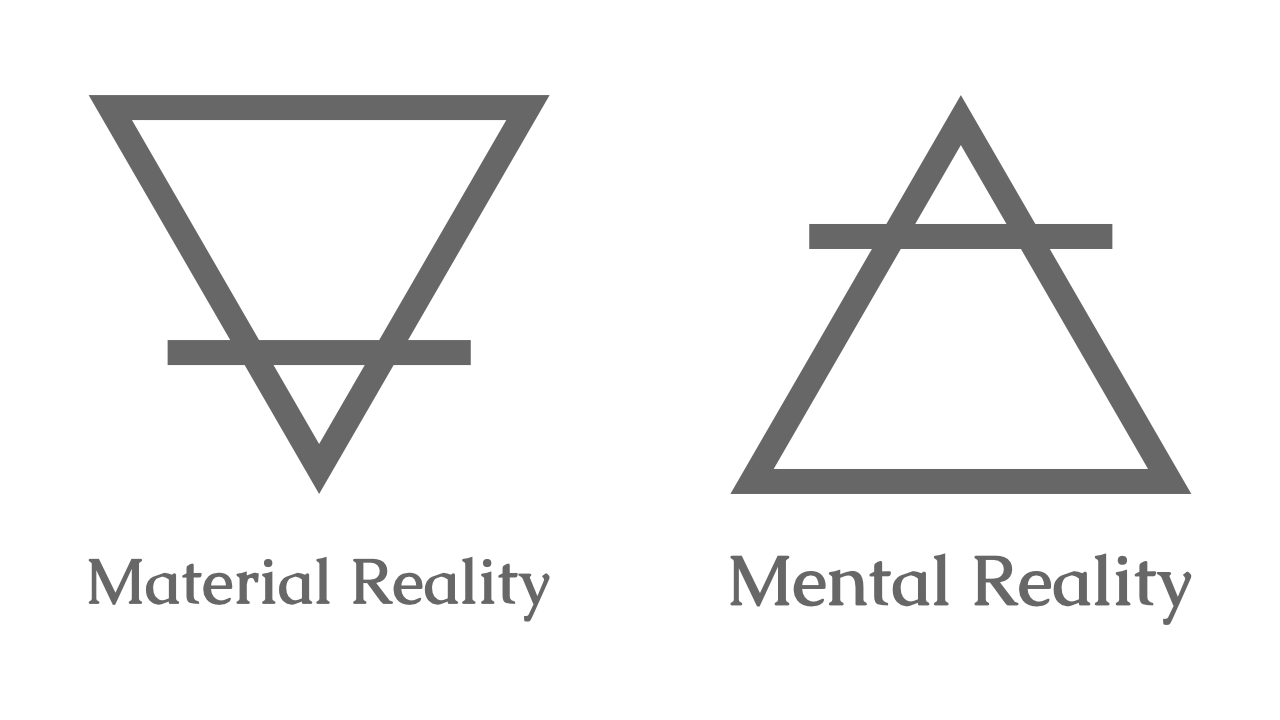
Using the alchemical symbols for Earth and Air, this diagram illustrates that Draper’s “Material Reality” is collapsible downward to a certain threshold, at which we find a sort of ‘fundamental materiality’, and his “Mental Reality” is collapsible in the opposite direction toward a threshold of the ‘most fundamental Mental Reality’, i.e. the World Soul (or Cosmic Mind). This idea bridges modern Platonic Idealism to ancient Platonism and actually resembles Plato’s “unwritten doctrines”, wherein from a top-down perspective everything comes from The One, but bottom-up everything is only collapsible to the Indefinite Dyad (which is also called the-great-and-the-small or the-one-and-the-many). Plato taught that everything is collapsible to Mind, and yet still dual in its physical expression. If we overlap or ‘collapse’ the separate Material and Mental realities above into one diagram, where the Material and the Mental co-exist in such a way as to keep their ‘fundamentalities’ separate, we are left with another alchemical symbol which is a diagram of the cosmos:

Orphism posits that “God” is the sum total of everything. Everything that exists, exists within God. It is perhaps no small coincidence that, in Orphism, this all-encompassing divinity is called the Aither. Multiple Gods in the Orphic Hymns are called Aitherial or aerial, in reference to their ‘immaterial’ or ‘intangible’ qualities. A few are even said to deliver Souls to mankind. The Derveni Papyrus, the oldest commentary on anything Orphic, explicitly and systematically collapses all of the Gods to a single divinity, which is similarly equated with air. The Rhapsodies and various other Theogonies explain first the emanation of the Cosmos, and then the birth of a natural force of Divinity (and by extension, Souls) within it. Aetherism, then, is not simply a modern philosophy which incorporates an Orphic worldview: Aetherism is a modern philosophy which arrives independently at a position which may be better explained by the Orphic worldview.
Draper wraps up his paper by saying “again, there are no free lunches” and that scientifically, this would add consciousness as another fundamental interaction alongside gravity, electromagnetism, and the nuclear forces. Asking “is that any more absurd” than denying the points of the quadrilemma, he says “it seems not.”
In the final paragraphs, he points to mysticism as “empirical (though not scientific) evidence” for the theory. “Mystics from a variety of religious traditions claim to experience being absorbed into God… or even being identical with God.” He also cautions “keep in mind that many of these mystics have very strong reasons not to blur the distinction between themselves and God because to do so is heretical in the religious traditions to which they belong”. This is true of Orphism as well, and avoiding hubris is a major factor for one’s Soul to escape the cycle of rebirths and ascend back to the Aither as a participant solely in Draper’s “Mental Reality”.
To end the paper, Draper says that perhaps a better name for his theory would be Panpsychentheism (or “all-minds-in-God-ism”), to place it among the usual arguments of classical theism (God-created-everything-ism), pantheism (everything-is-God-ism), and panentheism (everything-is-within-God-ism). It seems, though, in light of its many similarities to Orphism, that perhaps the name ‘Aetherism’ is perfect.

I don't find the concept of minds being emergent properties or functions to be unreasonable given we find emergentism occurring everywhere else. For example, photosynthesis emerges from things that are not themselves photosynthesizing, and so on.
Humans seem fascinated with the specialness of our own minds, to the point where "conscious" becomes some ontological differentiator, but there's no reason to assume they are not just another very cool phenomena like anything else. Spend enough time around people with brain damage and the concept of "mind is located in the brain but does not come from the brain" seems like a dodge that again would never be entertained for any other phenomenon.
Perhaps it may be useful to differentiate consciousness itself from the rest of the mind (cognition, memory, emotion, etc.) because people often try to bootstrap the former as a fundamental aspect of reality (which is possible!) to preserve the eternity of the latter (i.e. their ego).